Pressure Points: What Really Moves a Shelter Toward No Kill?
Unpacking the Political, Financial, Reputational, and Community Levers Behind Change—And the Role of the ACSMM™ as a Tool for Clarity
Introduction
The evolution of animal shelters from traditional models—where euthanasia was a routine yet often unexamined practice—to the aspirational “No Kill” standard marks one of the most profound shifts in modern animal welfare. But beneath the surface of progress lie subtle, complex forces that either propel or resist change.
Understanding what truly moves a shelter toward No Kill is essential—not just for animal advocates, but for policymakers, shelter leaders, and the communities they serve.
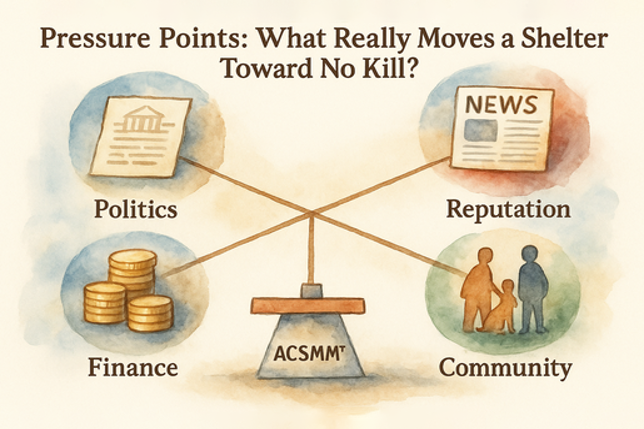
This article examines the core levers of pressure—political, financial, reputational, and community-based—that drive or inhibit transformation. It also introduces the Animal Care Shelter Maturity Model™ (ACSMM™ ) as a strategic, neutral tool that surfaces hidden barriers and builds the structural clarity needed for lasting reform.
Political Pressure: The Top-Down Driver
Most public shelters operate under the authority of local or county government. In these systems, elected officials and agency leaders hold disproportionate influence over shelter direction. When these leaders are aligned with unconventional outcomes, change can move swiftly. When they are indifferent—or worse, antagonistic—shelter reform is slow to nonexistent.
But politics is responsive to pressure. The right kind of data, media attention, or community organizing can shift the calculus. ACSMM™ assessments can help advocates and stakeholders bring a facts-based narrative to political decision-makers who otherwise may not engage.
Financial Pressure: Cost, Incentives, and Misconceptions
Some assume that achieving No Kill is too expensive. In truth, the cost of inefficiency, burnout, poor planning, and frequent turnover is often far greater.
Shelters without mature systems hemorrhage money through:
Inefficient intake and outflow
Missed grant opportunities
Reactive decision-making under crisis
Legal costs tied to poor practices
ACSMM™ data helps reframe financial conversations. When cities can clearly see where maturity saves money—and where current systems fail—the return on investment becomes more compelling.
Reputational Pressure: Optics, Shame, and Hope
Shelters do not operate in a vacuum. Their public image can inspire support or provoke backlash. And while public shaming is rarely the first choice of change agents, it is sometimes a last resort when other doors remain closed.
At the same time, public praise is a powerful motivator. When shelter leaders see a roadmap toward recognition, community celebration, and industry validation, many will walk it.
The ACSMM™ introduces measurable stages of maturity, allowing shelters to own their growth, broadcast their progress, and take pride in their evolution.
Community Pressure: The Voice of the Public
Communities often want more humane outcomes but lack the language, access, or tools to demand better. Sometimes, the shelter itself blames “the public” for failure: not enough adopters, not enough fosters, too many surrenders.
But in truth, communities can be mobilized—as funders, as advocates, and as partners.
The ACSMM™ helps create transparency. When a shelter scores itself and shares results, it invites the public to be part of the solution rather than a scapegoat for failure.
Resistance to Change: The Hidden Force
Even when all other levers align, leadership resistance can stall progress indefinitely. In some cases, the shelter director may be unwilling to adopt lifesaving practices. In others, staff may fear job loss, workflow disruption, or loss of authority.
This is why external structure matters.
The ACSMM™ offers a non-threatening, facilitated framework for addressing difficult questions:
What are we really doing?
Where are we strong?
Where do we need help?
What would it take to evolve?
Sometimes, just asking these questions in a neutral setting is enough to prompt movement.
Conclusion: Pressure with Purpose
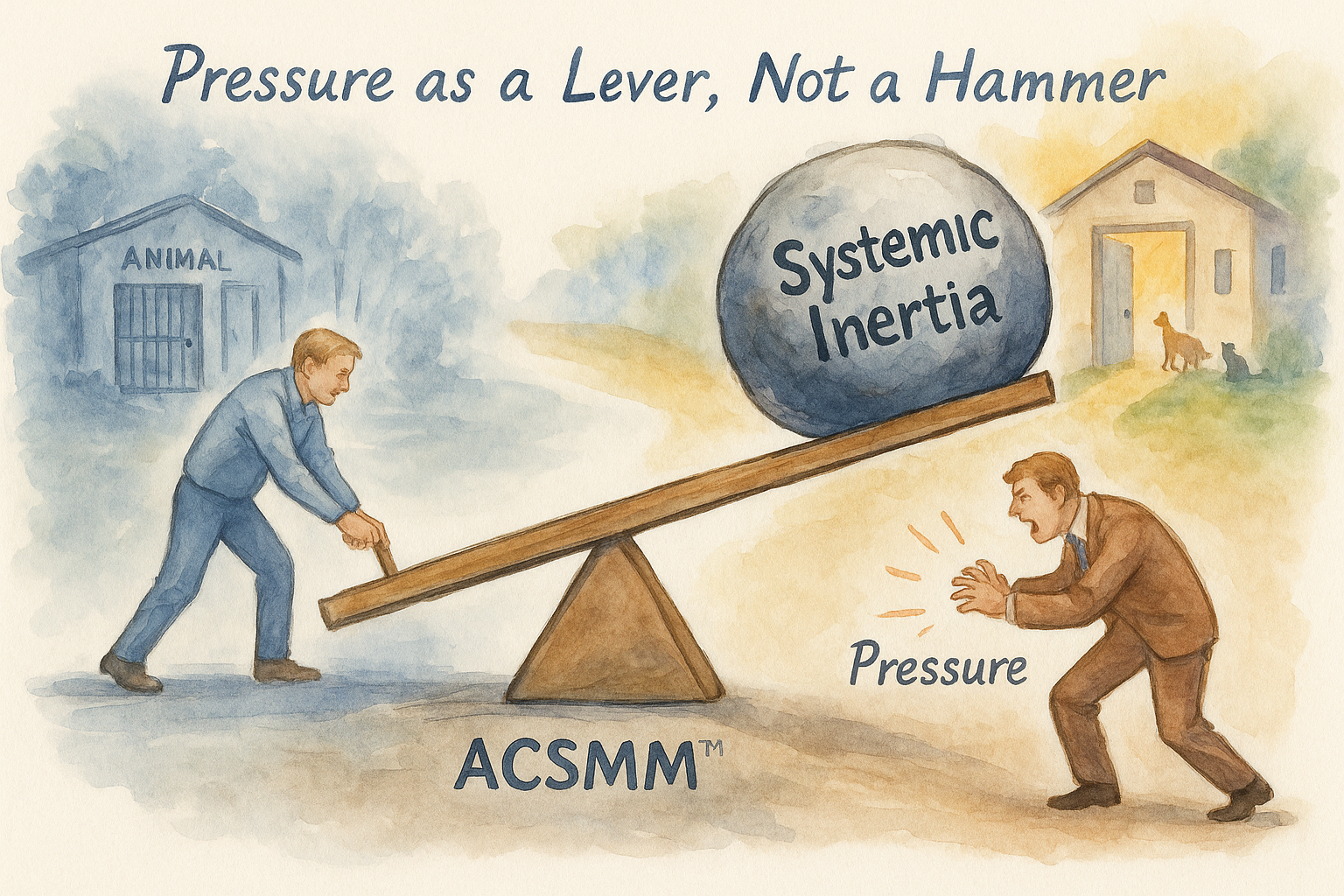
Shelters don’t change because someone shouts louder. They change because the right kind of pressure is applied at the right time—with clarity, credibility, and compassion.
The ACSMM™ is more than a model—it is a mechanism for movement. It reveals gaps not to punish, but to plan. It informs public discourse. It empowers funders and stakeholders. And it provides shelter leaders with something they rarely have in chaotic environments: a clear way forward.
If we want to accelerate lifesaving, we must learn to use pressure not as a hammer—but as a lever. The ACSMM™ helps us find the fulcrum.
The No Kill ACSMM™ Institute
ACSMM™ | Advancing and Accelerating the Path to Shelter Lifesaving
If your organization is interested in:
• Becoming an early adopter or pilot partner
• Helping test or refine ACSMM tools
• Exploring how the model complements your current strategies
“Let’s connect and explore how we can advance lifesaving together.”
Marv Serhan
Founder & Director, The No Kill ACSMM™ Institute
www.acsmm.org | marv@acsmm.org