Scaling Lifesaving: How a Structured Maturity Model Could Strengthen the Heigl/Riverside Framework — and Beyond
A potential model for data-driven animal shelter reform — a roadmap of structured progress, transparency, accountability, and collaboration toward sustainable No-Kill outcomes.
The Shift from Compassion to Structure
Every transformative movement in animal welfare begins with compassion. But compassion alone—no matter how heartfelt—cannot sustain progress across a system as vast and complex as animal sheltering. The partnership forming between the Heigl Foundation and Riverside County represents a rare opportunity to prove that structure and empathy are not opposing forces but complementary ones. The question now is how to convert a promising partnership into a replicable framework for measurable, lasting change, not just regionally, but across the state and eventually, nationwide. To understand where structure can make the greatest difference, we first need to examine the landscape in which Riverside County operates.
The Challenge: Inconsistent Systems, Uneven Results
Riverside County Department of Animal Services (RCDAS) grapples with several significant challenges in fulfilling its mission. These challenges are not uncommon in other cities and states across the nation as they contend with all facets of shelter management, community engagement, and regulatory compliance. Specifically for Riverside County:
The RCDAS faces persistent challenges rooted in systemic gaps: chronic pet overpopulation strains shelter capacity, resulting in high euthanasia rates—especially among cats. Limited funding and staffing constrain operational effectiveness, while increasing animal cruelty cases demand significant resources for intervention. Public engagement and education on responsible pet ownership remain inconsistent, further complicating intake reduction. Fragmented data reporting, shifting resource allocation, and episodic progress across municipalities prevent the establishment of a stable, scalable foundation for lasting improvement. Collectively, these factors underscore the need for a unified, structured approach to drive sustainable change countywide. Riverside County is one of the nation’s largest counties, representing an ideal testbed for a scalable approach.
The Opportunity: A Framework for Measurable Change
The path forward may lie in structured, evidence-based frameworks long used in other complex enterprise-wide industries — maturity models that help organizations measure where they are, define where they want to go, and chart a realistic, data-informed path between the two. The No Kill ACSMM™ Institute, in response to the need for a framework to support the animal sheltering sector, developed the Animal Care Shelter Maturity Model™.
The ACSMM is the first evidence-based roadmap, industry-specific maturity model designed for animal care shelters. It provides a roadmap for sustainable operational excellence, aligning day-to-day shelter practices with long-term No-Kill outcomes. It helps shelters:
Baseline their current operations across 8 core domains and 6 maturity levels
Set meaningful aspirational goals tailored to their community
Identify critical gaps through real-time Compass survey scoring
Generate a step-by-step roadmap of prioritized improvements
Track progress through annual re-assessments and facilitator guidance
Ultimately the ACSMM is designed to help shelters of every size progress from reactive to strategic operations, guided by measurable indicators, shared accountability, and data transparency.
The Heigl/Riverside Application: A Pilot in Collaboration
A regional initiative like the Heigl/Riverside collaboration could demonstrate the power of structured alignment — connecting municipal shelters, rescues, and veterinary partners under a common improvement roadmap. Each participant would benchmark their current level of maturity, identify priority gaps, and move upward through evidence-based practices, supported by shared data and academic oversight.
With university partners documenting outcomes and the Heigl Foundation providing philanthropic alignment, the model could yield something the field has long sought — measurable, reproducible, and transparent progress.
Operational Readiness and Requirements: The Pilot Backbone
While Riverside and its partners would ultimately define the detailed requirements, certain operational foundations tend to determine the success of any regional transformation effort. A Heigl/Riverside pilot could begin by establishing:
• Unified Data Standards – Agreement on how intake, outcome, and population metrics are defined and reported across all participating shelters.
• Shared Performance Benchmarks – Common indicators of progress toward community-wide goals such as intake reduction, live release rates, and spay/neuter reach.
• Shelter-Specific Adaptability – Flexibility to tailor strategies to local demographics while maintaining consistent county-level reporting.
• Transparent Governance – Publicly available dashboards and progress reports that invite accountability and build trust.
• Academic Evaluation Framework – An independent partner to design data collection methods, verify outcomes, and publish results.
• Resource Alignment and Staff Development – Integrating workforce training and philanthropic funding with measurable operational priorities.
These are the kinds of structural pillars that an ACSMM™-guided roadmap could support, creating the consistency, comparability, and transparency needed for sustainable lifesaving at scale.
Applying Structure to the Foster, Spay/Neuter, and Transparency Challenge
Recent reporting about Riverside County’s foster-to-adopt and sterilization practices underscores why structured frameworks are urgently needed. The ACSMM™ directly addresses these weaknesses by embedding data transparency, program integrity, and accountability into each domain of shelter operations.
Within the ACSMM™ framework, shelters establish verifiable checkpoints that ensure:
Real-Time Data Integrity: Intake, foster, sterilization, and adoption data are continuously tracked and reported through standardized metrics, closing the gaps between reported and actual outcomes.
Independent Evaluation: Academic or third-party partners validate outcomes and assess compliance, ensuring objective accountability beyond internal reporting.
Comprehensive Follow-Up: Every foster placement includes an evidence-based lifecycle checkpoint to confirm sterilization, welfare status, and outcome documentation.
Transparent Public Reporting: Regular, public-facing dashboards and scorecards make progress visible to the community and funders, replacing narrative claims with measurable proof.
Beyond these corrective measures, the ACSMM™ enables Riverside and other counties to transition from reactive, crisis-based decision-making to predictive, data-informed operations—a shift that transforms transparency from an aspiration into an operational standard. In this way, the ACSMM™ transforms the very elements of reform that are being called for in Riverside—turning the conversation about transparency into a system that produces it.
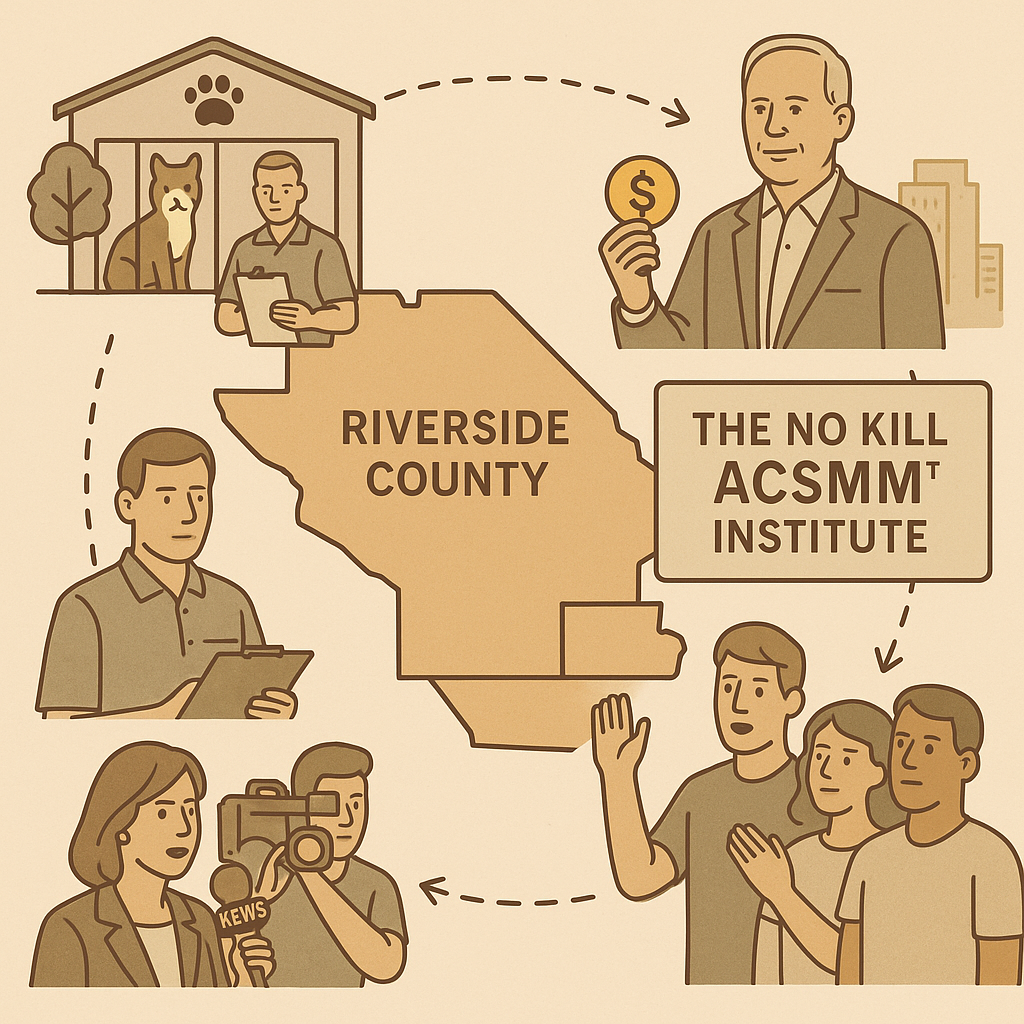
Partnership-driven reform: The No Kill ACSMM™ Institute provides the structure to help Riverside County and similar communities achieve measurable, transparent, and sustainable lifesaving outcomes.
The Broader Implication: Statewide Transformation
What begins as a focused collaboration in Riverside could evolve into a statewide framework — a model for California, and eventually, for any state seeking consistent, humane, and transparent sheltering standards. The adaptability of the ACSMM™ makes it possible to scale without prescribing a one-size-fits-all solution, honoring the diversity of communities while ensuring shared accountability.
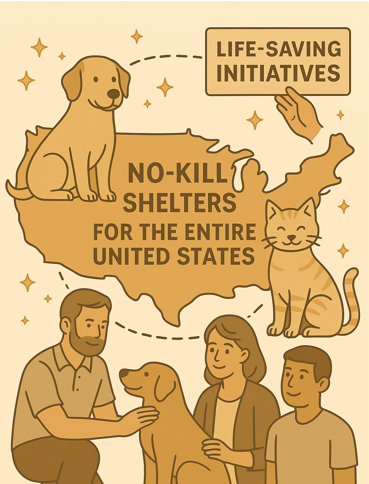
From pilot to national model: The ACSMM™ framework provides the roadmap for scaling structured, transparent, and data-driven No-Kill outcomes across the United States.
Ensuring Lifesaving Goals and Operational Sustainability in Riverside County
Riverside County has established a clear objective for its sheltering operations: to achieve and maintain a 90% no-kill rate across all facilities. This ambitious lifesaving goal is grounded in a commitment to animal welfare and sets a high standard for operational success. However, experience from shelters nationwide reveals that even when organizations reach a 90% live release rate, sustaining this achievement can be challenging. Progress is often vulnerable to setbacks when key leaders retire, staff turnover occurs, funding decreases, or unexpected crises arise. These disruptions can lead to a decline in performance and create instability within the organization.
The absence of a resilient and enduring structure makes it difficult to preserve gains over time, raising an important question: How can shelters establish processes that foster organizational learning and guarantee operational sustainability in the long term? Addressing this challenge is essential to ensure that lifesaving practices become institutionalized and that progress does not erode due to changing circumstances.
The ACSMM mitigates that risk by institutionalizing lifesaving practices. It introduces common language, consistent metrics, and a framework that can outlast any one leader or initiative. With a shared structure to guide decision-making, shelters can:
Strengthen cross-department coordination
Improve grant readiness and board communication
Foster organizational learning and staff retention
Demonstrate transparency to communities, funders, and partners
Enhance the sharing of best practices and lessons learned between shelters nationwide
Stakeholder Benefits
For funders, the ACSMM™ provides measurable accountability. For university partners, it offers a living laboratory of applied research. For shelter professionals, it delivers clear guidance, data tools, and peer learning opportunities. For the public, it ensures transparency and trust. And ultimately, for the animals themselves, it means lives saved — and the chance to live them fully.
Closing Reflection: Compassion, Science, and Sustainability
While compassion is often the catalyst for lifesaving efforts in animal sheltering, it is the integration of science, structured frameworks, and collaboration that ensures these efforts are maintained over time. A maturity-model approach, such as the ACSMM™, provides a reliable method not only for measuring progress but also for sustaining it. By combining compassion with accountability and embracing innovation supported by evidence, shelters can cultivate a culture where lifesaving is consistently structured, measured, and sustained, rather than being sporadic or exceptional.
Implementing frameworks like the ACSMM™ allows compassion to be translated into measurable outcomes, promotes shared accountability among stakeholders, and ensures that progress is sustainable. The collaborative efforts initiated in Riverside County have the potential to serve as a blueprint that extends beyond the local level, guiding shelters, counties, and regions across the state toward a unified standard of excellence.

A nation connected by compassion and structure—each shelter a light in a growing network of lifesaving change. Together, they form a movement where empathy is organized, progress is measurable, and every life matters.
If the partnership between philanthropic organizations, public service entities, and scientific approaches exemplified by the Heigl/Riverside initiative can be effectively modeled, the impact could reach far beyond Riverside. This alignment has the potential to transform a local achievement into a statewide template and, ultimately, a national turning point for animal welfare, setting a new standard for shelters across the country. Together, these efforts move animal sheltering from good intentions to measurable transformation — a future where compassion is structured, transparent, and enduring.
Author Note
Concept developed by Marv Serhan, Founder of The No Kill ACSMM™ Institute (a 501(c)(3) nonprofit organization). The Animal Care Shelter Maturity Model (ACSMM™) provides a structured framework for advancing animal shelter performance through data-informed maturity modeling, measurable accountability, and academic collaboration.
For more information or collaboration inquiries, visit www.acsmm.org.