Arête (ἀρετή): The Foundation of Sustainable Excellence in Animal Care Sheltering
How a Timeless Virtue Shapes Modern Leadership, Accountability, and Lifesaving Systems
Arête — the disciplined pursuit of excellence — is not a philosophical abstraction. In animal sheltering, it is a daily necessity.
Shelters operate under extraordinary pressure: high intake, limited resources, public expectations, political constraints, and the moral weight of life-and-death decisions. Compassion alone cannot carry that burden. What sustains progress—what prevents burnout, drift, and systemic failure—is a culture grounded in excellence of purpose, practice, leadership, and accountability.
Arête provides the standard.
ACSMM™ provides the structure to achieve it.
The Leadership Demands of Modern Sheltering
Animal sheltering is uniquely challenging. It requires:
Decisiveness under pressure
Emotional resilience
High-stakes prioritization
Coordination across multiple functions
Stewardship of public trust
A deep commitment to animal welfare
These challenges are magnified in large municipal systems, but even the smallest rescue organizations feel the strain. Global examples—from the Netherlands’ strict regulatory framework to the Galápagos Islands’ aggressive approach to population control—demonstrate that outcomes improve when leadership, structure, and accountability work together. Yet even well-funded or highly regulated systems falter when practices depend on individual heroics rather than institutional maturity.
Arête reminds us that excellence is not episodic. It is cultivated, practiced, and sustained.
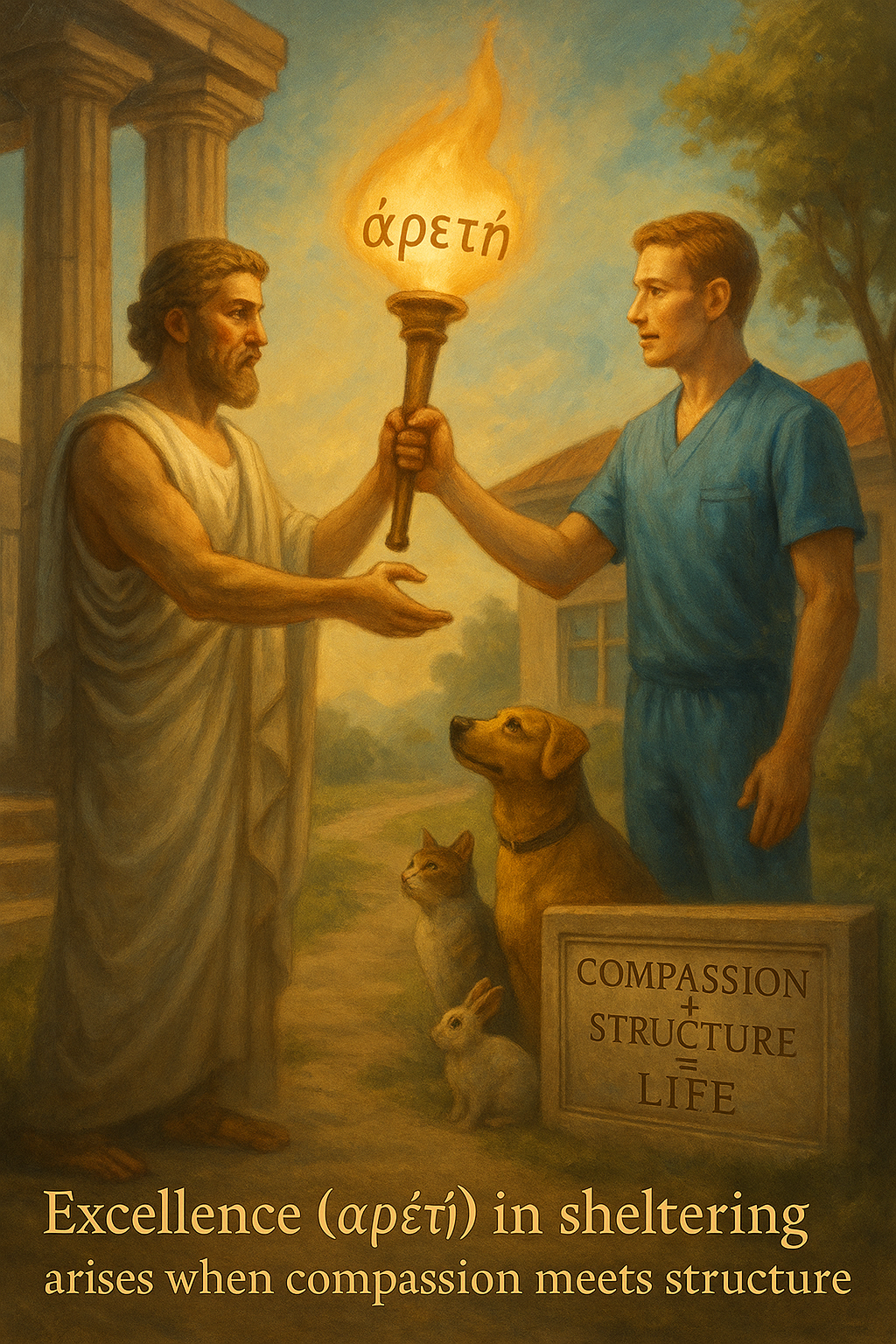
Arête: the enduring virtue that guides compassionate action with disciplined structure.
The Moral Dimension: Character in Action
The pursuit of excellence is fundamentally a moral act.
It requires leaders who:
Tell the truth about what is happening inside their organization
Reject convenient narratives that obscure systemic weaknesses
Remain accountable even when outcomes are uncomfortable
Choose transparency over perception
Make decisions rooted in principle, not expediency
Arête demands internal honesty.
It is the quiet courage to measure what matters, confront what is real, and improve what is broken.
In this respect, excellence is not merely operational—it is ethical.
Why Good Intentions Are Not Enough
Many shelters are filled with dedicated, compassionate teams who care deeply for the animals. But compassion, without structure, cannot overcome the predictable stresses of high-volume operations. When systems are immature or poorly defined, staff find themselves:
Reacting rather than leading
Fighting symptoms rather than causes
Repeating crises rather than preventing them
Burning out rather than improving
Inconsistent processes, unclear decision pathways, and siloed operations do not merely reduce efficiency—they erode morale, trust, and outcomes.
This is where Arête transitions from philosophy to practice.
Arête in Practice: From Virtue to Systems
In ancient Greek thought, Arête represented the highest and best use of one’s capabilities. For organizations, this means:
Building systems that perform reliably
Establishing clarity of purpose
Creating alignment across teams
Being accountable to measurable standards
Learning continuously from experience
These are not abstract ideals—they are practical necessities for sustainable lifesaving.
Shelters that embody Arête:
Make decisions with discipline
Implement processes with consistency
Evaluate outcomes with honesty
Improve operations with intention
Protect their teams from avoidable strain
Serve their communities with integrity
Arête elevates the work from reactive service to deliberate stewardship.
Where Arête Meets Structure: The Role of ACSMM™
The Animal Care Shelter Maturity Model™ (ACSMM™) translates the principles of Arête into a structured, operational roadmap.
It does this by:
Defining what maturity looks like across eight critical organizational domains
Clarifying the difference between aspiration and practice
Revealing gaps that compassion alone cannot see
Linking excellence in leadership, operations, and culture
Providing a pathway to move from short-term effort to long-term sustainability
And critically:
The ACSMM™ is a learning system.
Every shelter assessment, pilot evaluation, global case insight, and operational lesson strengthens the model. It evolves as the field evolves. It becomes more capable as more shelters engage with it. In this way, ACSMM™ embodies Arête: the ongoing pursuit of improvement and excellence, not a static declaration of success.
This is what distinguishes ACSMM™ from one-time interventions, grant-driven programs, or episodic reform efforts.
It is built for longevity, adaptability, and institutional growth.
Global Insights: What Excellence Looks Like Abroad
Around the world, systems that achieve consistent animal welfare outcomes share three attributes:
1. A clear moral framework
Whether explicit or implicit, they operate from a shared understanding of what excellence requires—and why it matters.
2. A unified operational structure
Regulations, processes, and standards reinforce the moral framework.
The Dutch model is an example: stringent controls paired with high accountability.
3. Institutional maturity
Success does not depend on an individual leader.
It persists across political, financial, or organizational changes.
These insights echo the fundamental message of Arête: excellence must be cultivated, measured, and maintained.
Why Arête Matters Now
Animal welfare is experiencing a period of strain—rising intake, post-pandemic instability, workforce shortages, political pressure, and public scrutiny. These challenges expose weaknesses that surface in every community, not just high-intake regions.
Arête offers a stabilizing force.
It calls organizations to rise above crisis-driven habits and to build systems capable of sustaining lifesaving outcomes—day after day, year after year.
Shelter leaders who embrace Arête:
Strengthen their organizational culture
Improve decision-making clarity
Reduce preventable harm
Build public trust
Retain capable staff
Increase lifesaving capacity
This is not theoretical. It is observable across shelters that commit to excellence with the same seriousness they commit to compassion.
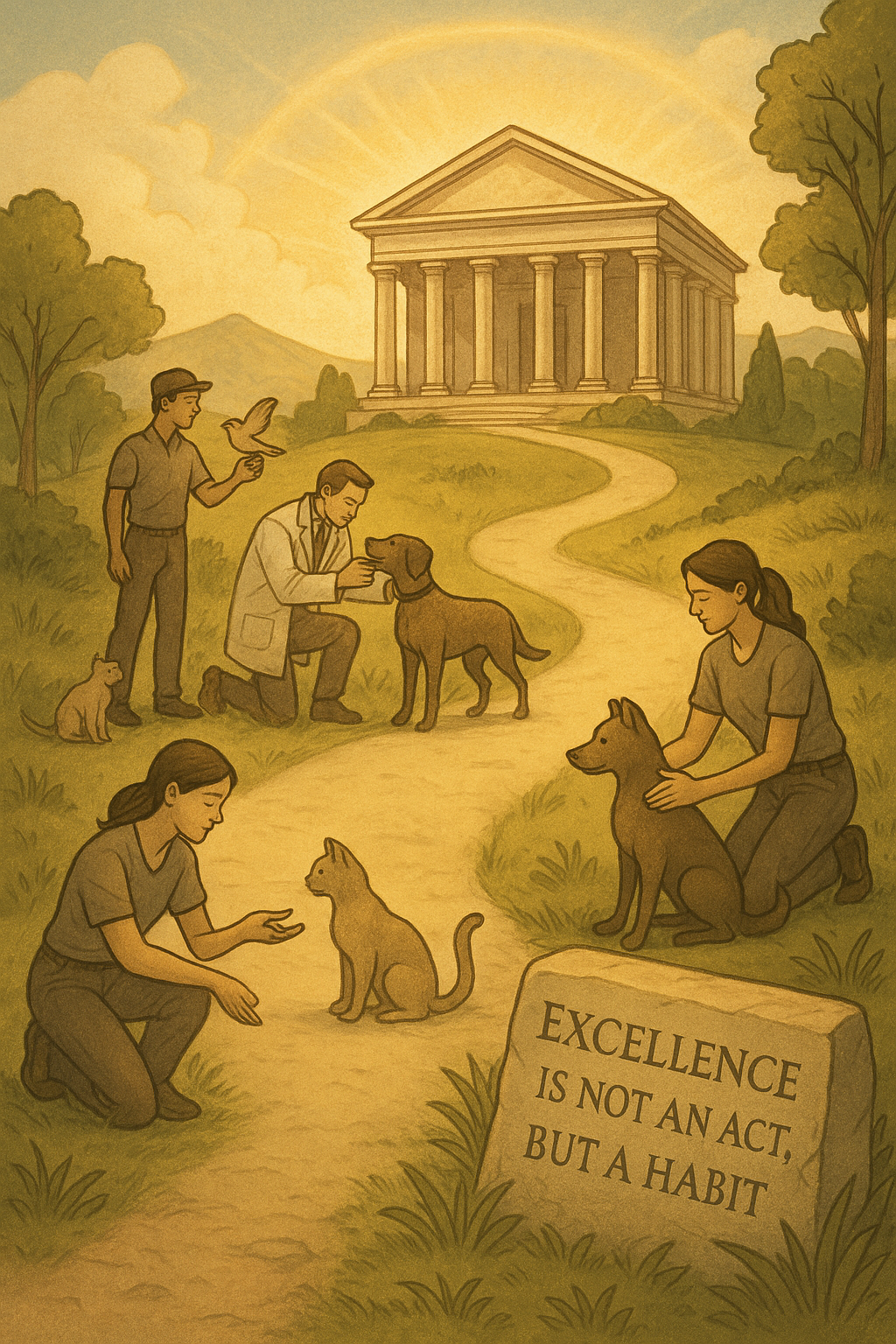
Excellence in sheltering emerges from repeated, disciplined habits — not isolated moments of effort.
Conclusion: Excellence as a Habit
Excellence is not an act. It is a habit.
It is built—quietly, deliberately, and persistently.
Arête is the virtue that calls leaders and organizations to the highest expression of their purpose.
ACSMM™ is the framework that guides them there.
Together, they form a pathway toward sustainable, principled, and effective sheltering—one capable of honoring both the animals and the people who serve them.
The pursuit of Arête is not optional.
It is the foundation of every lifesaving system that endures.
Authorship
Published by The Animal Care Shelter Adaptive Maturity Model™ (ACSMM) Institute