Beyond Static Maturity: Why Animal Sheltering Requires an Adaptive Model
Animal shelters do not operate in stable environments. Every day, conditions shift—sometimes gradually, often without warning. Intake rises. Length of stay increases. Medical and behavioral needs escalate. Staffing fluctuates. Capacity tightens. Decisions must be made quickly, including decisions relevant to life and death, and once made, they cannot be undone.
In this environment, outcomes are not theoretical. They are immediate. And they are permanent.
Yet many of the systems used to guide shelter operations were not designed for this reality. They were built for stability.
The Limits of Static Thinking
For many decades, maturity models have long been used to improve performance in structured environments. They provide defined stages of progression, standardized practices, and pathways for long-term improvement. In the right context, they work well. But animal sheltering, where life and death decisions hang in the balance, is not that context.
Traditional models rely on periodic assessment and incremental change. They assume that conditions can be evaluated, plans developed, and improvements implemented over time. They assume that performance can be adjusted gradually.
In animal sheltering, that assumption breaks down. Conditions do not wait for evaluation cycles. System load does not stabilize on command. Outcomes cannot be deferred while plans are refined.
What should be manageable becomes overwhelming. What should be routine becomes crisis.
Not because people are uncommitted. Not because effort is lacking. But because the system itself is not designed to readily adapt to rapidly changing real-world conditions. For example, if a shelter never integrated training procedures that applied to both routine and surge events, their performance during an actual environmental disaster or law enforcement action would be less than optimum. That reality is much too common. It is time for change.
Training for the Conditions That Exist
In certain disciplines, there is a simple standard: We train the best to handle the worst. The purpose is not to achieve excellence under ideal conditions. It is to ensure reliability under the most demanding ones. That principle applies directly to animal sheltering.
Surge conditions—intake spikes, capacity constraints, resource strain—are not rare events. They are recurring features of the environment. Yet many organizations are not structured or conditioned to operate effectively within them. As a result, performance becomes inconsistent. Decision-making degrades under pressure. Systems drift. More importantly, the animals don’t get a say. They often pay the price.
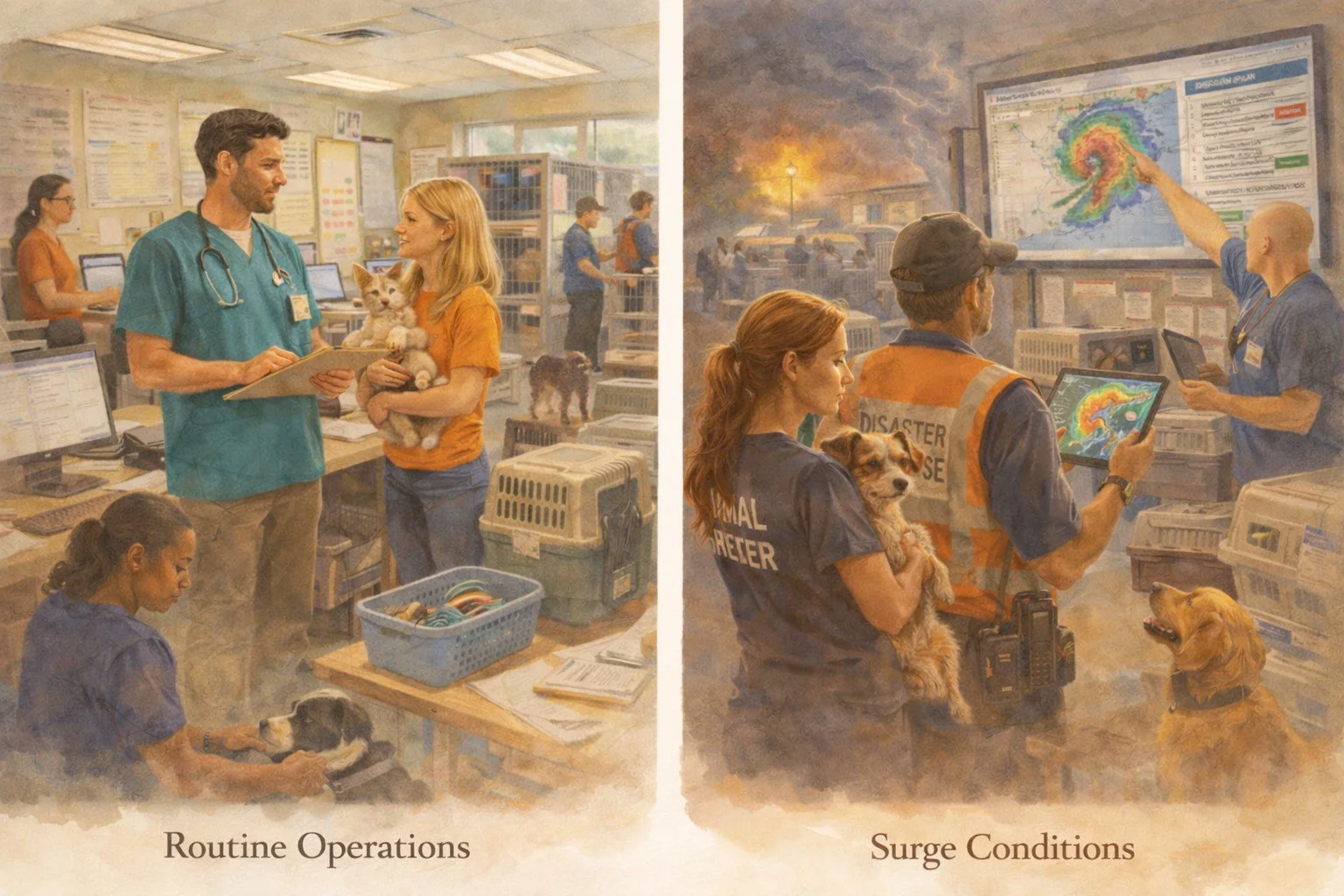
Adaptive maturity takes a different approach. It does not treat high-pressure conditions as exceptions. It treats them as part of the operating environment. Daily operations are not separate from surge conditions—they are preparation for them. In similar fashion to the Profession of Arms, members train the way they intend to fight. In an adaptive animal care shelter, staff operate with the expectation that conditions will change—and that they must be ready to respond without hesitation.
The same system must perform in both routine and surge operating conditions.
This is not a theoretical standard. It is an operational requirement.
From Assessment to Execution
The Animal Care Shelter Adaptive Maturity Model™ (ACSMM™) represents a fundamental shift.
It moves beyond static evaluation and fixed roadmaps toward continuous, signal-driven execution.
Instead of asking: “What level are we at?” It asks: “What is happening right now—and what must we do next?” This shift changes everything. Maturity is no longer defined by position on a scale. It is defined by the ability to respond effectively to real-world conditions as they occur.
Seeing What Matters—When It Matters
At the core of adaptive maturity is visibility. Not periodic reporting. Not retrospective analysis.
But continuous situational awareness. Shelters operate under varying levels of pressure. Load increases and decreases. Capacity tightens and relaxes. Risk accumulates—sometimes gradually, sometimes rapidly. Without visibility, these changes remain partially hidden until they become unmanageable.
With consistent focus on situational awareness, change can be addressed early.
The concept is simple: Load is not a static measure. It is a dynamic condition. Understanding that condition in real time—through indicators such as intake pacing, length of stay, medical and behavioral risk, and overall system strain—allows leadership to act before performance degrades. Adaptivity is not just awareness. It is awareness combined with the ability to respond.
From Information to Action
Information alone does not change outcomes. What matters is how quickly it leads to action.
In many systems, data is collected, summarized, and reported after the fact. By the time insights emerge, conditions have already shifted. Adaptive maturity closes that gap. Signals are not collected for reporting—they are used to guide decisions in real time. They reveal conditions that are not always visible such as a gradual increase in length of stay that quietly reduces available capacity, or a rise in behavioral incidents that signals mounting system stress before it becomes unmanageable. Signals aligned with pre-determined thresholds further enhance tactical reaction timing. They trigger adjustments in operations. They help leadership maintain control before systems begin to fail. This is not about reacting faster. It is about preventing the need to react at all.
A System Designed for Real Conditions
Animal shelters do not operate as plans or processes. They operate in real time. Animals do not experience systems as frameworks or strategies. They experience them through outcomes—whether they receive care, whether they are placed, whether they sense fear or danger, whether they even survive.
Across the industry, recent events continue to demonstrate that without adaptive structure, even well-intentioned systems degrade under pressure.
When that degradation occurs, the consequences are not abstract. They are immediate and irreversible.
This is why structure, transparency, visibility, and accountability are not enhancements—they are operational requirements.
The ACSMM Difference
The Animal Care Shelter Adaptive Maturity Model™ is built specifically for this environment. It is:
Signal-driven, not checklist-driven
Adaptive, not static
Behavior-based, not aspirational
Context-aware, not one-size-fits-all
Applicable to all animal shelters regardless of demographic
It does not impose uniform solutions. It aligns decisions with actual conditions—within each shelter’s unique operating environment. The result is a system that:
Supports consistent decision-making
Maintains performance under pressure
Adapts as conditions change
Keeps lifesaving at the center of every action
Learns continuously from both internal performance and external industry experience, strengthening its ability to adapt over time.
What This Makes Possible
When shelters operate with adaptive maturity, several things begin to change:
Problems are seen earlier
Decisions are informed by real conditions
Systems respond before failure occurs
And most importantly, outcomes become more consistent—not because conditions are stable, but because the system is capable of optimizing people, process, and technology to contend with all scenarios as they occur.
This is the difference between managing a process and maintaining control of a system.
A Different Standard
Lifesaving success is not achieved through intention alone. It requires systems that can function under pressure, adjust in real time, and sustain performance despite changing conditions. The Adaptive Maturity Model™ was built to meet that standard. Not an idealized version of sheltering. But the one that exists and can be optimized to ensure lifesaving remains the priority.
Conclusion
No single intervention will resolve the challenges facing animal sheltering. Prevention efforts such as high-volume spay and neuter programs are essential to reducing the number of animals entering the system. At the same time, shelters must be equipped to manage the reality of the animals already in their care.
The solution is not one or the other. It is both.
External prevention reduces incoming pressure. Adaptive operational management ensures that remaining pressure is handled effectively, consistently, and humanely.
When these two approaches operate in balance—prevention on the outside, adaptive control on the inside—the system begins to stabilize. Intake pressure decreases. System performance improves. And most importantly, the need for euthanasia as a function of capacity diminishes.
Prevention + Adaptive Maturity = Lifesaving Sustainability
Authorship
Published by The Animal Care Shelter Adaptive Maturity Model™ (ACSMM) Institute